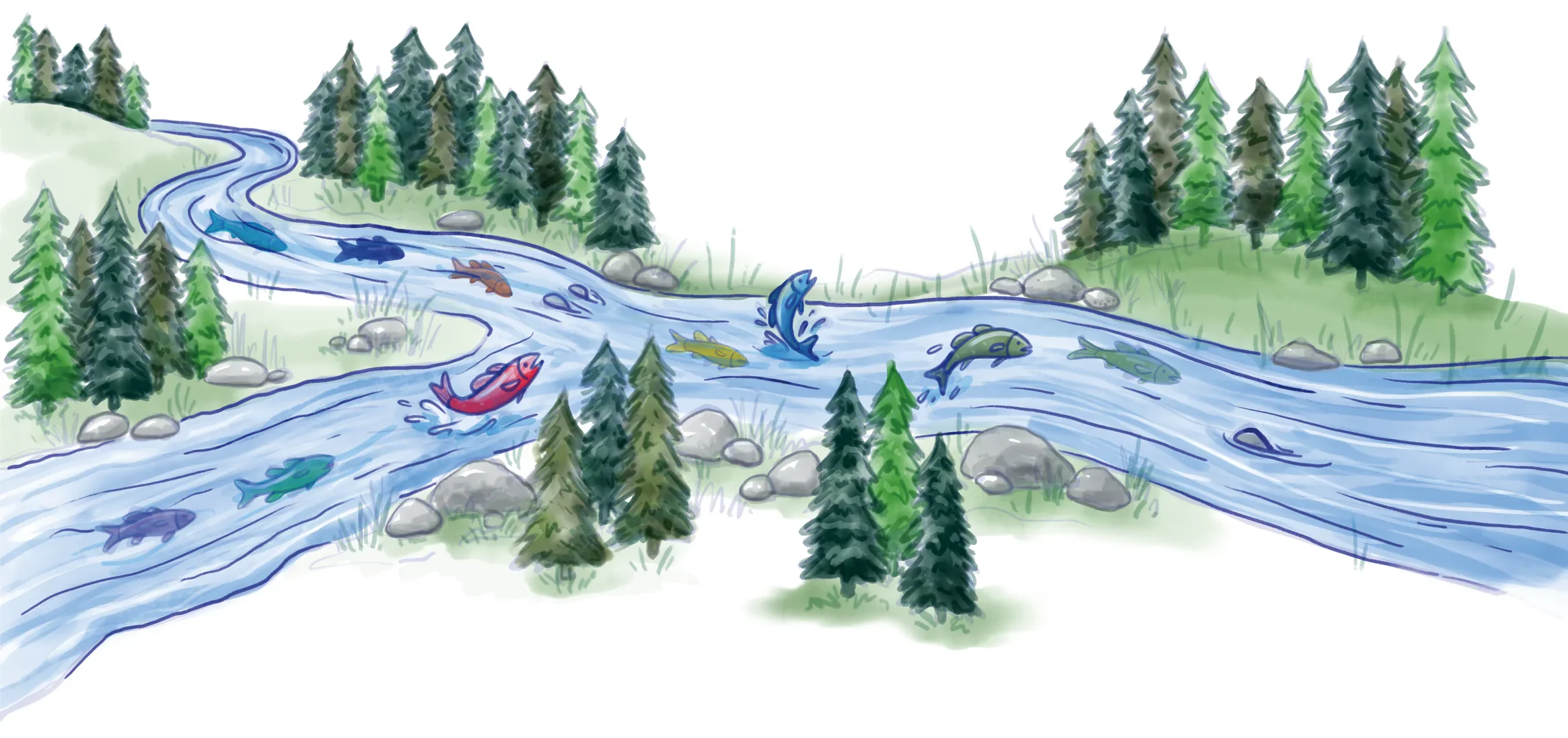
The image of the two rivers in the introduction to this guide symbolizes two worldviews on learning, knowledge and education. One represents Indigenous ways of knowledge; the other, westernized ways of knowledge production. Although there are certain similarities, each of these rivers represents a distinct approach to learning, shaped by its own logic, function and pace. Each carries its vision of what it means to acquire and transmit knowledge and to support personal growth.
This guide aims to create a meeting place between these two rivers. It urges us to look beyond a narrow view of academic success, limited to classrooms, standardized curricula and test results, to adopt a more global, holistic and relational approach to education. The meeting of these two visions depends on a respectful dialogue that recognizes orality as a foundational method of knowledge transmission and a vital means of fostering mutual understanding.
The development of this guide is explicitly rooted in a commitment to responding to call for action 62 in Honouring the Truth, Reconciling for the Future, the final report of the Truth and Reconciliation Commission of Canada, published in December 2015. The Commission was created in 2009 with the mandate to examine the impacts of the residential school system in Canada and to gather testimonials from survivors and other people affected by this system. Call for action 62 invites governments and educators, in collaboration with Indigenous peoples and survivors, to integrate Indigenous knowledge, teaching methods and realities into education systems, ensure teachers have the proper training and reinforce intercultural understanding, empathy and mutual respect.
This is the context for this Competency 15 Guide, proposed by the First Nations Education Council (FNEC). As an organization made up of 22 member communities from eight Nations, the FNEC recognizes the diversity of the educational realities and worldviews that coexist within its communities. The guide reflects this diversity and does not purport to be universal or exhaustive. This proposal is rooted in the expertise of the FNEC and the diversity of its members, resulting from a process based in reflection, dialogue and knowledge-sharing.
The purpose of this guide is to present what competency 15 represents overall and holistically, by providing conceptual frameworks and exploratory avenues to support its integration and its development in education. The approach adopted is based on a vision of lifelong learning that respects each individual’s pace, personal journey and the order in which learning becomes meaningful.
This guide is primarily intended for individuals in teacher training, regardless of the path they take to become teachers. It also serves as a reference tool for all educators seeking to reflect on and evolve their practices in a spirit of reconciliation, respect and recognition of Indigenous knowledge.
As an evolving document, the goal is to transform and enhance this guide over time. It is a starting point to stimulate reflection, support action and encourage engagement. Readers are invited to adapt the proposals presented to their own context and add their own knowledge, voices and experiences to benefit all students in the educational network.